Why Is My Aircond Leaking Water from the Indoor Unit?
Aircond leaking water from the indoor unit? Common causes are blocked drainage, a dirty coil, or ice melt. Here's how to diagnose and fix it.
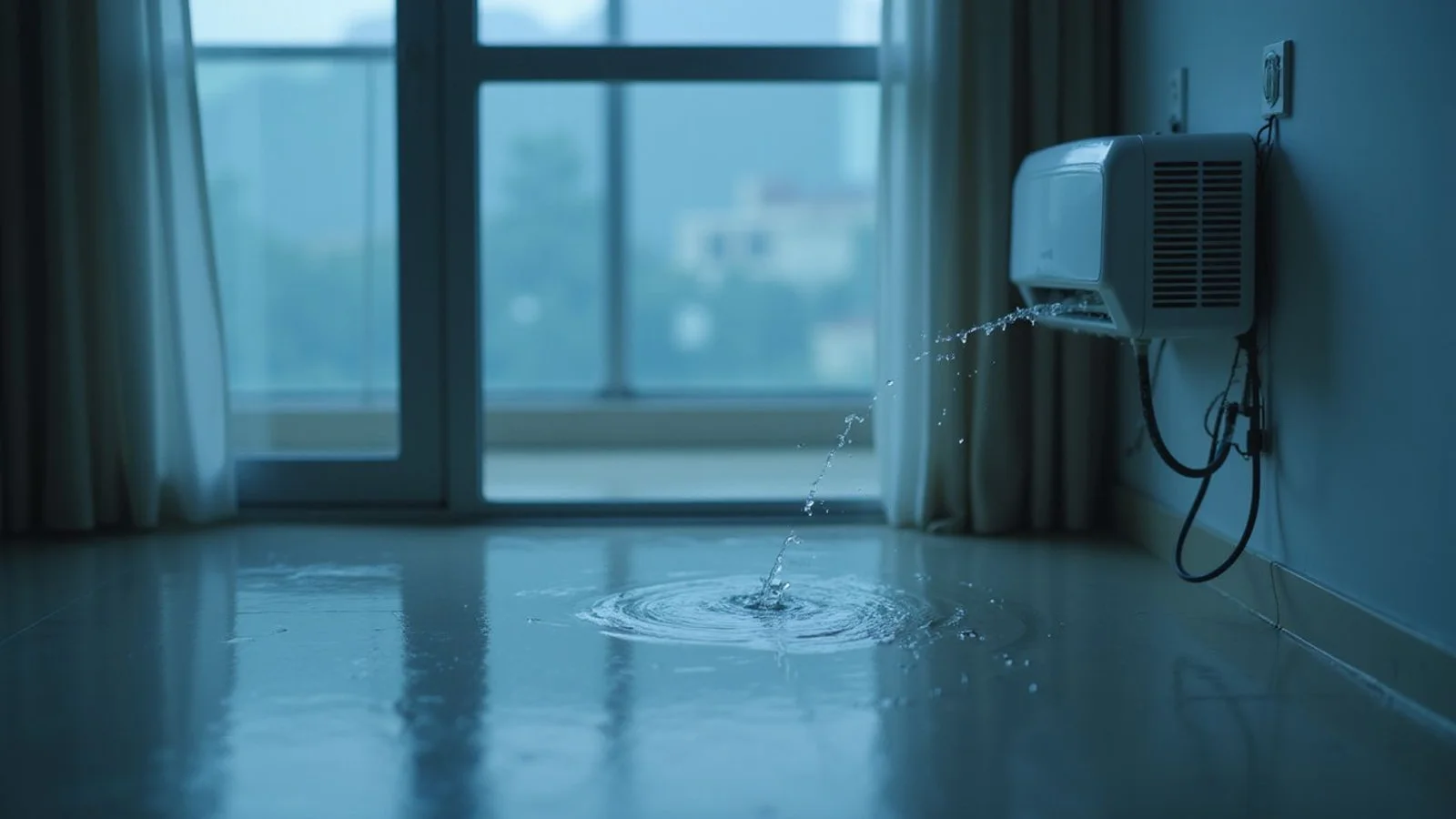
Our team receives frantic calls about an aircond leaking water indoor unit every single day across Kuala Lumpur. Seeing a sudden puddle on your laminate floor is definitely a stressful moment.
We know exactly how disruptive this water damage is for your home or small business.
The good news is that the root cause is rarely a total system failure. Our experience shows that the appliance is usually just producing condensation faster than the pipe can drain it away. Let’s look at the data, see what it actually tells us about your cooling system, and explore a few practical ways to fix the problem fast.
How the drainage system actually works
Every air conditioner acts as a giant dehumidifier for your room. Our technicians explain this basic cooling process to customers during almost every service visit.
Kuala Lumpur’s average relative humidity often hovers around 80 percent throughout the year. We see this heavy airborne moisture get pulled inside and pass over the cold evaporator coil. Condensation naturally forms on this surface, drips into a specific water tray, and flows outside through a PVC drainage pipe.
Our daily operations rely on this exact drainage path staying completely clear. When a blockage occurs, that trapped water quickly backs up and spills directly into your living space.
The main components handling this constant water flow include a few key parts:
- Evaporator coil: The cold copper tubes where room moisture collects.
- Condensate drain pan: The plastic tray positioned underneath to catch immediate drips.
- Drainage pipe: The PVC line routing the collected liquid to the exterior.
The most common cause: blocked drainage
Our internal data confirms that nearly 80 percent of all water leak complaints stem from a clogged drain line. This specific issue is the absolute most frequent culprit for an aircond water drip in Malaysia.
We find three primary offenders causing these stubborn blockages in local residential properties:
- Mould and jelly slime. The cool, damp interior of a PVC pipe is a perfect breeding ground for biological growth. This algae often forms a thick jelly that completely stops water flow.
- Dust and debris. Heavy particulate matter bypasses dirty filters and washes directly into the drain pan.
- Pests and geckos. The Asian house gecko loves the dark, cool environment of a wall pipe. These small lizards frequently crawl inside, get stuck, and create a solid physical blockage.
A professional technician easily resolves this by disconnecting the pipe and clearing the obstruction. Our standard procedure involves flushing the line out with a high-powered wet vacuum.
This targeted flush instantly clears the line and stops the leak in its tracks. We highly recommend a full chemical wash, which typically costs around RM150 in the KL area, to dissolve any remaining biological slime. Chemical cleaning ensures the pipe stays clear for a much longer period.
Other common causes
Complex internal faults will also force water out of the wrong places. Our maintenance crews regularly identify a few other distinct reasons for indoor flooding.
Dirty coil
A severely neglected filter forces the evaporator coil to collect a thick blanket of household dust. Our service teams frequently encounter coils so dirty that condensation cannot flow smoothly down the metal fins.
Instead of reaching the tray, water droplets form on the dirt layer and fall entirely outside the designated collection zone. We resolve this specific airflow issue by performing a thorough deep clean of the internal components. While a basic general service helps, a targeted chemical wash is the only way to remove years of caked-on grime.
Ice formation and melt
Low refrigerant pressure creates a freezing condition right on the indoor coil itself. Our diagnostic gauges will often show the system dropping below freezing during normal daily operation. Solid ice slowly builds up across the copper fins while the compressor runs.
We see the real disaster happen the exact moment you switch the appliance off. That thick ice melts far too rapidly for the standard pipe to handle, resulting in a sudden indoor flood.
Our experts always look for a white layer of frost on the copper pipe at the outdoor unit to confirm this diagnosis. The correct repair sequence is to perform a leak check, seal the hole, and then top up the refrigerant gas.
| Visual Cue | Likely Cause | Recommended Action |
|---|---|---|
| Water drips continuously while running | Dirty coil or blocked pipe | Chemical cleaning |
| Massive flood shortly after turning off | Frozen coil melting | Gas leak repair |
| Frost on exterior copper pipes | Low refrigerant level | Pressure test and top-up |
Installation fault
Brand new appliances should never drip, but poor workmanship certainly causes immediate drainage failure. Our installation experts always use a spirit level to ensure a perfect downward gradient.
Common installation errors by inexperienced contractors usually include a few key missteps:
- A drainage pipe routed uphill inside the wall cavity.
- The main indoor unit tilted slightly away from the exit hole.
- Loose or completely unsealed condensate pipe joints.
These structural faults often appear within the first few weeks of running a new system. We can usually correct these errors by re-mounting the metal bracket and resetting the pipe angle correctly.
Cracked or rusted water tray
Plastic collection components become highly brittle after enduring a decade of constant temperature shifts. We occasionally find hairline cracks or deep rust holes in the main water tray of older air conditioning units.
Water escapes straight through these tiny fissures long before it ever reaches the exit hole. Our repair protocol for this scenario requires completely dismantling the indoor housing to swap out the broken part. This fix definitely falls into professional repair territory because replacing the tray is an intricate job.
What you can safely check
Before scheduling a service call, there are a few safe troubleshooting steps you can try. We encourage customers to perform these quick checks to potentially save time and money.
- Switch the unit off at the breaker. Cut the power completely for a few minutes to reset the system if the cause is sensor-related.
- Find the outdoor drainage outlet. Locate the small pipe poking out of the wall on the same side as the exterior condenser.
- Look for visible blockage. Carefully clear away any leaf, insect, or gecko stuck right at the pipe opening.
- Check the indoor filter. Pull the mesh out, rinse it clean, and reinstall it to prevent airflow restriction.
A filter completely caked in dust will rapidly contribute to freezing conditions. Our maintenance guides consistently highlight monthly filter washing as your best preventive habit. If the aircond drainage blocked issue continues after these basic checks, the obstruction is likely hidden deep inside the wall.
When to call a pro
Certain operational symptoms indicate a complex problem that requires specialised diagnostic tools. We strongly advise you to stop running the appliance immediately if you notice any of these distinct warning signs.
- The leak returns within hours of clearing the outdoor drain.
- You can clearly hear gurgling inside the indoor unit during operation.
- Water is dripping fast in a steady stream rather than slow drops.
- The leak appears at the wall or above the casing, not directly from the plastic vent.
- You see yellow water staining your wall or ceiling plaster.
These situations demand either a proper high-pressure flush, a deep coil clean, or advanced troubleshooting. Our aircond servicing and cleaning team flushes the entire drainage route as a mandatory part of every single service.
Eliminating biological growth prevents these sudden overflow emergencies from happening again. We rely on our dedicated repair team to safely handle any complex diagnosis involving refrigerant leaks or failing compressors.
Don’t ignore it
Ignoring a persistent aircond leaking water indoor unit problem will eventually cost you a small fortune in structural home repairs. We have seen minor leaks destroy expensive laminate floors and ruin custom furniture in just a few days.
A professional pipe flush is incredibly cheap compared to a massive plaster ceiling replacement bill. We are fully equipped to resolve your dripping unit quickly and permanently.
WhatsApp +60 14-302 9055 with a clear photo of the leak and secure a same-day technician appointment where possible.
Need this service done?
See our Aircond Servicing & Cleaning →